I am doing my dream job. I am providing online cover teaching for a class of DP2 psychology students, mixed HL and SL, and thoroughly enjoying it! And so are the students, I believe, from the feedback. All your school needs is a decent Microsoft teams or Zoom account and a bit of imagination. I am being employed as an external independent consultant and of course I supply a detailed cv, refs and police check. And I hit the ground running! So, if you have a teacher whom you know will be absent for a few months, instead of trying to stretch other staff to cover them, maybe you might have found your dream solution. Feel free to private message me on FB or contact me through here. Laura 🙂
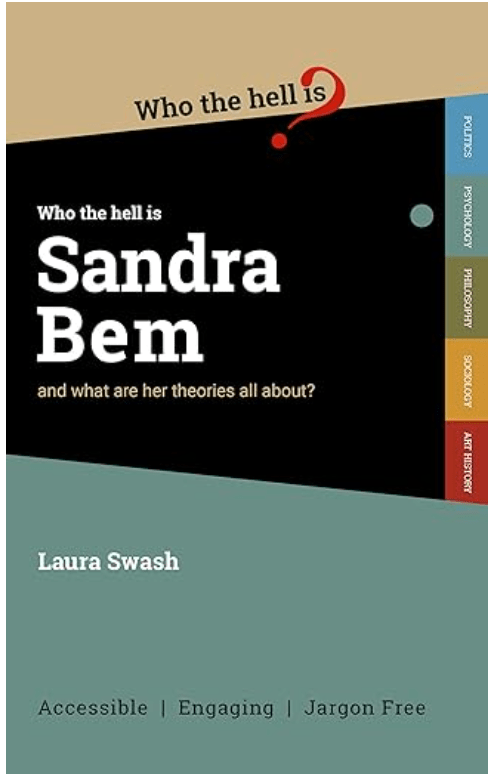
For anyone studying gender, gender schema theory, second-wave feminism, or just anyone who remembers the 1970s, this is a ‘must read.’ Sandra’s family generously shared photos of her and now the book is available as a Kindle edition for only £6.99. She was the most amazing woman!
The last piece of the IA puzzle Photo by Ann H on Pexels.com
References: It’s very important to ensure that you cite your sources in your IA text and have a short list of references/ works cited in alphabetical order of last name of author on a separate page after your Evaluation section. Not to do so means your IA will be flagged for academic dishonesty, and this puts your whole IB Diploma at risk. The minimum is to have the original study, the site[s] used for your inferential and descriptive statistical calculations, and the reference for any video, word list, photographs used.
Your school librarian will be able to help you with referencing in an academic style. It doesn’t matter which you choose, so long as you are consistent throughout your IA report. These sites are also worth a visit if you need more assistance:
At the very least your references page should include the original study that you have replicated, the websites that you used for your calculations, or for any videos or pictures that you used.
Appendices: These pages come after the references page, and contain your raw data, a blank example of your informed consent form (with space for parent signature if your participants are under 16), your standardised instructions (briefing), debriefing, materials and calculations (Screenshots are fine).
Use a separate page for each Appendix
Use a logical order: suggested is the order in which you use the materials, starting with the informed consent form, and ending with the debriefing.
Anonymise yourselves, your school and your participants. (This should also be done throughout the IA).
Ensure all screenshots of raw data and calculations are easily legible.
Rush it. Many good IA reports lose marks because students forget to put the raw data or calculations in the Appendices. Re-read your IA, and every time you say ‘We did…’ or ‘We gave …’ ensure you have the materials in the Appendices.
Substitute materials with hyperlinks or links of any kind to data sheets, etc. The marking software used by IB moderators does not allow them to follow links, so include all materials.
Include completed informed consent forms – just one blank form is sufficient.
After this, just sit back and be proud of yourself and your group. What an achievement!
For more help with your IA, don’t forget to visit the Psychology Sorted Youtube channel.
The IA Evaluation section is often seen as the most challenging section to write. But organisation is the key.
Have your other sections in front of you:
Introduction – with the description of your background theory
Exploration – your procedure, design and sampling technique
Analysis – your results from your descriptive statistics and inferential statistics
Organise the Evaluation by sub-sections:
Discuss your findings in relation to the background theory/model: What did you find? In which way[s] did they support/fail to support the model and (very briefly) why might this be?
What were the strengths and limitations of your design, sample and procedure? Take each one at a time and explain each strength and each limitation clearly. You only need one strength and one limitation for each of these. (Note: mistakes such as videos not working or a participant not coming are errors, not limitations.)
Taking each limitation in turn, describe how you could have modified the investigation to avoid this limitation. (Example: our participants showed tiredness or boredom in the second condition under our repeated measures design, even though we counterbalanced the conditions. We could have avoided this by substituting this design with a matched pairs design, where we match students in pairs according to their ability in ________________ [insert a relevant skill here].)
Check each of these sections to ensure that what you have written agrees with your previous sections. Although there are no marks given for a conclusion, a concluding sentence repeating your findings in relation to your hypothesis closes this section nicely.
Next, the References and Appendices.
For more help with your IA, don’t forget to visit the Psychology Sorted Youtube channel.
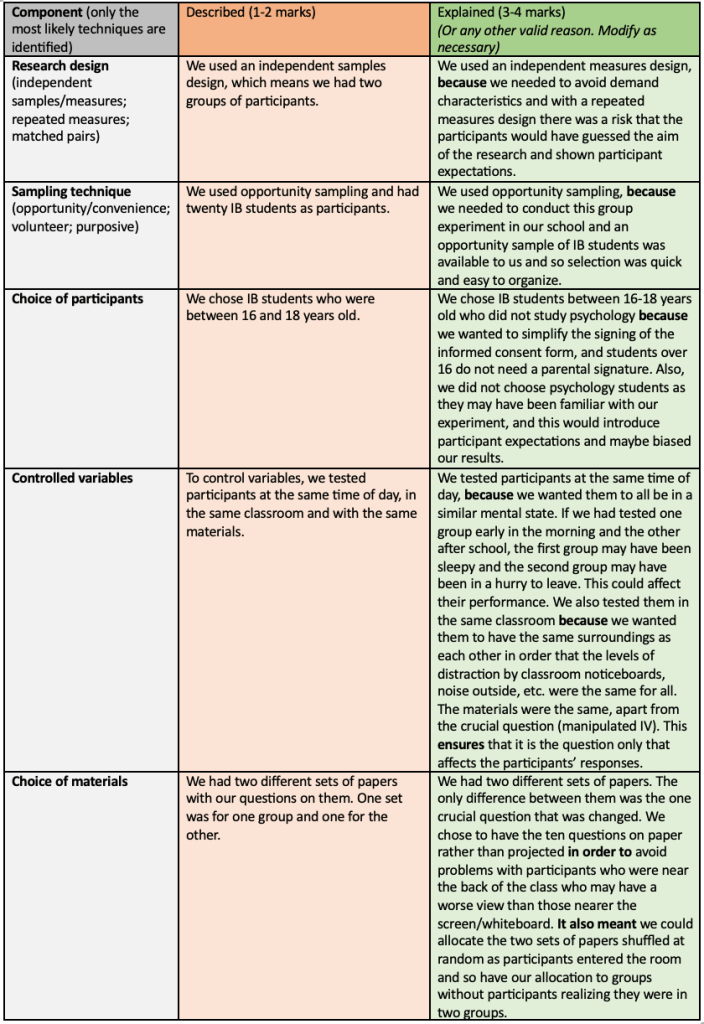
The Exploration section of your IA experiment is the simplest, providing you know the difference between ‘describe’ and ‘explain’! Hopefully this table below will help you. Remember it is only an example, but it shows how you should have your reasons for your choice clearly explained. And in your IA you do not put this in a table of course, you write it as script, with each of the components as a sub-heading. Good organisation means it is easy for teachers and moderators to understand what you are writing.
/For more help with planning your IA, don’t forget to visit the Psychology Sorted Youtube channel.
It’s IA time again – and your group has chosen a study, and is ready to get started. Now pause and check the following:
Which theory does your chosen study relate to and how can you explain this link?
What is your aim and how is this relevant to your participants?
What is the independent variable (IV) that you’re going to manipulate to make two conditions/groups?
What is the dependent variable (DV) that you’re going to measure and how are you going to measure it?
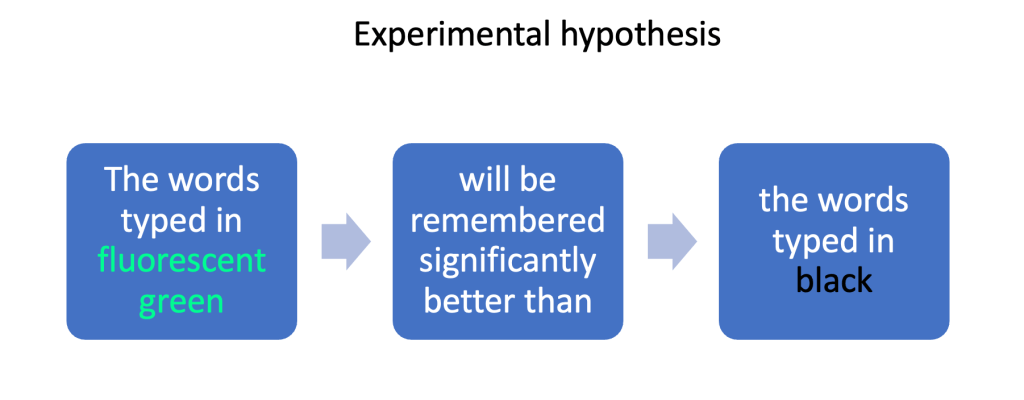
Once you have answered all of these questions, then you’re ready to predict what you think will happen. Will the IV have a significant effect on the DV, and how? This will be your experimental hypothesis. For example:
Looks pretty good, doesn’t it? (Make sure you are clear which is the manipulated IV and which is the measured DV.)
It could also be written as ‘Participants will remember the words typed in fluorescent green significantly better than the words typed in black.’ However, you still have to operationalise the IV (How many words of how many syllables, presented how?) and the DV (How will the memory for the words be tested?)
Once you have decided this, then you’ll be ready to plan exactly how your group is going to run this experiment. Which is what we will look at in the next post. Happy planning!
For more help with planning your IA, don’t forget to visit the Psychology Sorted Youtube channel.
Just click on the cover to buy the book for an amazing $3.25. Every penny made goes to Open Road Visions to help those with drug and alcohol dependency and to support those who love them. Extra-important in the festive season, which can be so challenging!
Schema Theory has been around a very long time. It is over 100 years since Bartlett conducted his first experiments on perception and memory at the University of Cambridge, and his book Remembering, written in 1932, is fascinating. He used a repeated reproduction method (where the same participant does a written reproduction of a story at different time intervals after hearing the original). Later he used a serial reproduction method (where different participants pass their written reproduction of the story on from person to person, with only the first seeing or hearing the original). He used an unfamiliar Native American story and his British students to show that memory is an “imaginative reconstruction” based on schemata (schemas) that are themselves developed through the senses and experience (Bartlett, 1932). We want to understand the unfamiliar and therefore we try hard to shape it to fit our preconceptions. The term schema or schemata (plural) was not invented by Bartlett. It was first used in psychology* by Piaget in 1923, but it fits the example of memory as well as it fits Piaget’s example of cognitive development of children.
Explains Everything? When we look at this in a little more detail, it becomes clear that schema theory can be applied to heuristics (thinking fast/system 1 thinking), stereotyping, human relationships, child development and mental health. For example, in 1976, Aaron Beck developed his theory of “dysfunctional schemas” being responsible for major depression. In 1954 Allport pointed out that cognitive processes, such as categorisation, underlie stereotyping. Schemas are categories, frameworks or mental representations and so may be used to explain all human behaviour, it seems, that is based on perception, thought or memory, which seems to encompass pretty much everything in cognitive psychology!
Critics of schema theory point to this tendency for it to be able to explain all our cognitive processes and any actions based on them. Psychologists such as Cohen (1993) have argued that it is a vague concept. It also does not explain how we understand new information that has no link to any of our pre-existing schemas. Of course, Bartlett would have replied that we change it to fit what we know, but this seems to exclude novelty and creativity in our understanding.
However, until we have something better, schema theory seems to explain and predict most human behaviour, and maybe this should be seen as a strength, rather than a limitation.
*Philosophy students may point out that the concept of schema was used by Kant in the Critique of Pure Reason, first published in German in 1781. But we can disregard that for our purposes.
Have you been caught out by the need for exams, even though you and your students have been under lockdown for months? Or would you just like a summary of all the classic and modern studies you’ll ever want? Then Psychology Sorted can solve your problems. Order the Kindle version (just $10.59 at the moment!) for instant access to everything you need to help your students revise, or have the beautiful hard copy for your own bookshelf. Available on all Amazon sites. https://tinyurl.com/y95phpw3 And please leave us a review
This is our latest film on the Psychology Sorted Youtube channel. There is plenty on this blog about how to write your IA, but this video will help you think through the data-collection process when your group is working remotely. How do you obtain informed consent? How do you get your participants? How do you get enough participants? How do you control the variables, debrief participants and share the data collection?
We also provide a useful IA proposal sheet that you, the student, should submit to your teacher for approval before starting to conduct your experiment.
Watch out for more useful Psychology videos this week!
So you’ve ‘pulled it all together’ and written your draft extended essay. Exciting times! Your references are all in alphabetical order, you’ve used 12 pt academic font and double-spaced and numbered your pages. It’s looking good and you’re feeling great!
However, before you hand your precious work in to your supervisor for the one and only piece of written feedback you’re allowed, pause for a few hours, or even days. Take this document, which is already set up with the top band descriptors for every criterion, and go through your essay yourself. Then give your self-assessment to your supervisor with your draft. Unless you decide after doing this that there is more work to be done before you hand in your draft, of course!
Of course, this is only possible if you have a few days. If you have just hurled your essay at your supervisor a few minutes before the deadline, then send them this link and they can use it to give you feedback on your work.
For those of you wanting some extra help/guidance/just for interest here is a link to my youtube channel and a unit of work on the Sociocultural Approach, Culture and its Effect on Behaviour. Play the video and carry out the tasks. Enjoy!
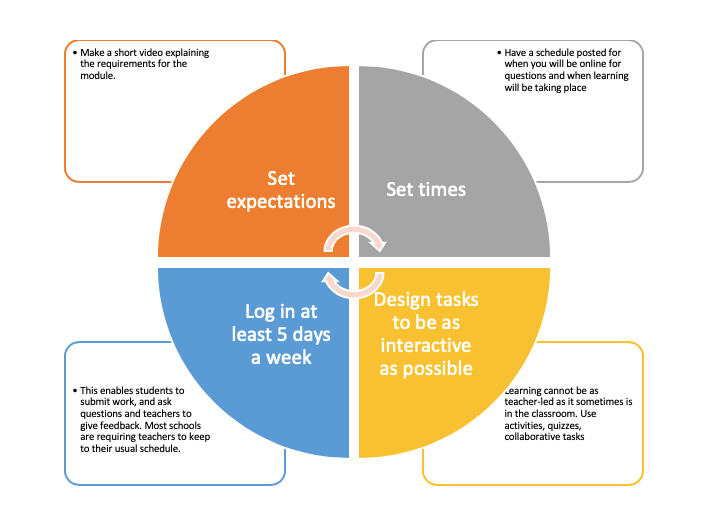
Many of us are now teaching our classes through a virtual learning environment. Most had very little notice, maybe one or two days, and are now on the steepest learning curve ever. Here are a few tips, followed by some very useful sites and links:
Several online sites are very kindly offering teachers free access to psychology resources for at least a month, and often through to the end of June 2020.
Zoom.us – not resources, but a great free meeting platform for running discussion groups
Thank you to those teachers who have sent their students home with copies of Psychology Sorted. Our sales have held steady through March, and we’re sure, with the key studies summaries, QR codes and links to many online resources, all students will appreciate this.
Finally, for those who would like to use psychology as a lens for discussing the current pandemic:
Asian news article from 6 weeks ago about reactions to the coronavirus. Interesting in retrospect.
I am sure there will soon be more resources available on this topic.
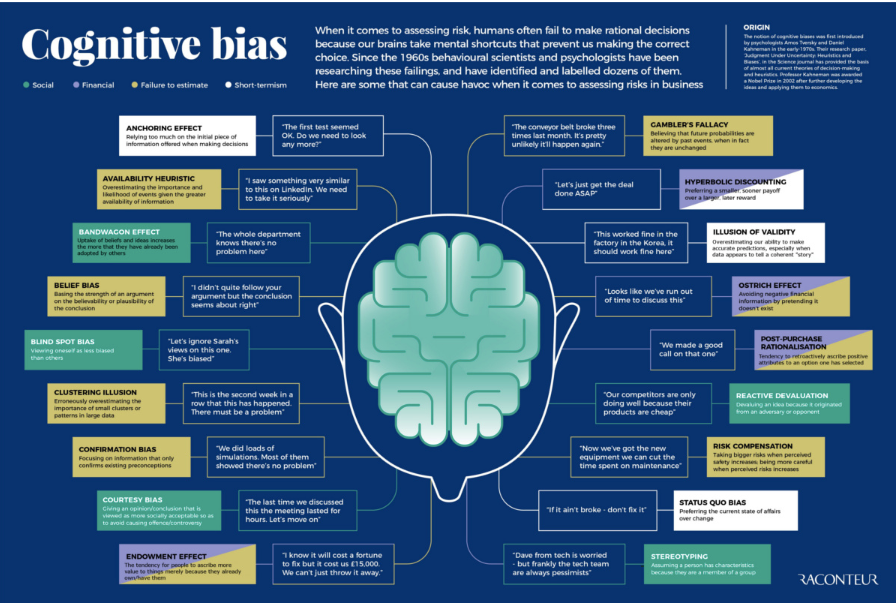
Cognitive biases like those listed on the Raconteur site (see this link, and below) can be a useful way to describe not only our own reaction to all the troubling news of the Covid-19 virus, but also to analyse the ever-changing reactions of some of the more prominent politicians! Here’s hoping your families and you keep safe, and stay online 🙂
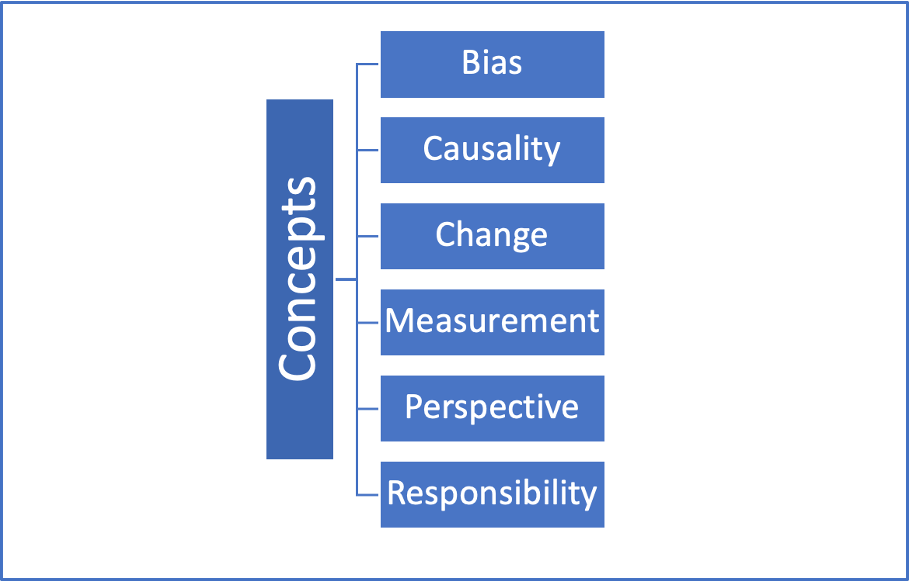
The new psychology curriculum guide will be published on MyIB on Tuesday 4th February. It is for teaching from August/September 2025, and there are a lot of changes to the approach to learning, though not so many to the content. You will be glad to learn, however, that the rote learning of studies is very much reduced as the focus shifts to understanding and making curriculum links through the six main concepts.
The six concepts
An example of how they may be used within a context is:
Human relationships
Bias – in the study of human relationships, the research method used is often questionnaires or interviews. How might these methods lead to bias in the findings?
Causality – how is it possible to identify causality within complex group behaviour?
Change – what is the role of intrinsic motivation in the formation of interpersonal relationships?
Measurement – discuss how triangulation could be used in the study of factors influencing interpersonal relationships.
Perspective – evaluate a reductionist approach in the study of interpersonal relationships.
Responsibility – discuss how ethical considerations may affect findings in the study of group behaviours.
These are questions that we already ask in the current psychology curriculum. The new curriculum is now making them an integral and explicit part of learning.













 Psychology Sorted